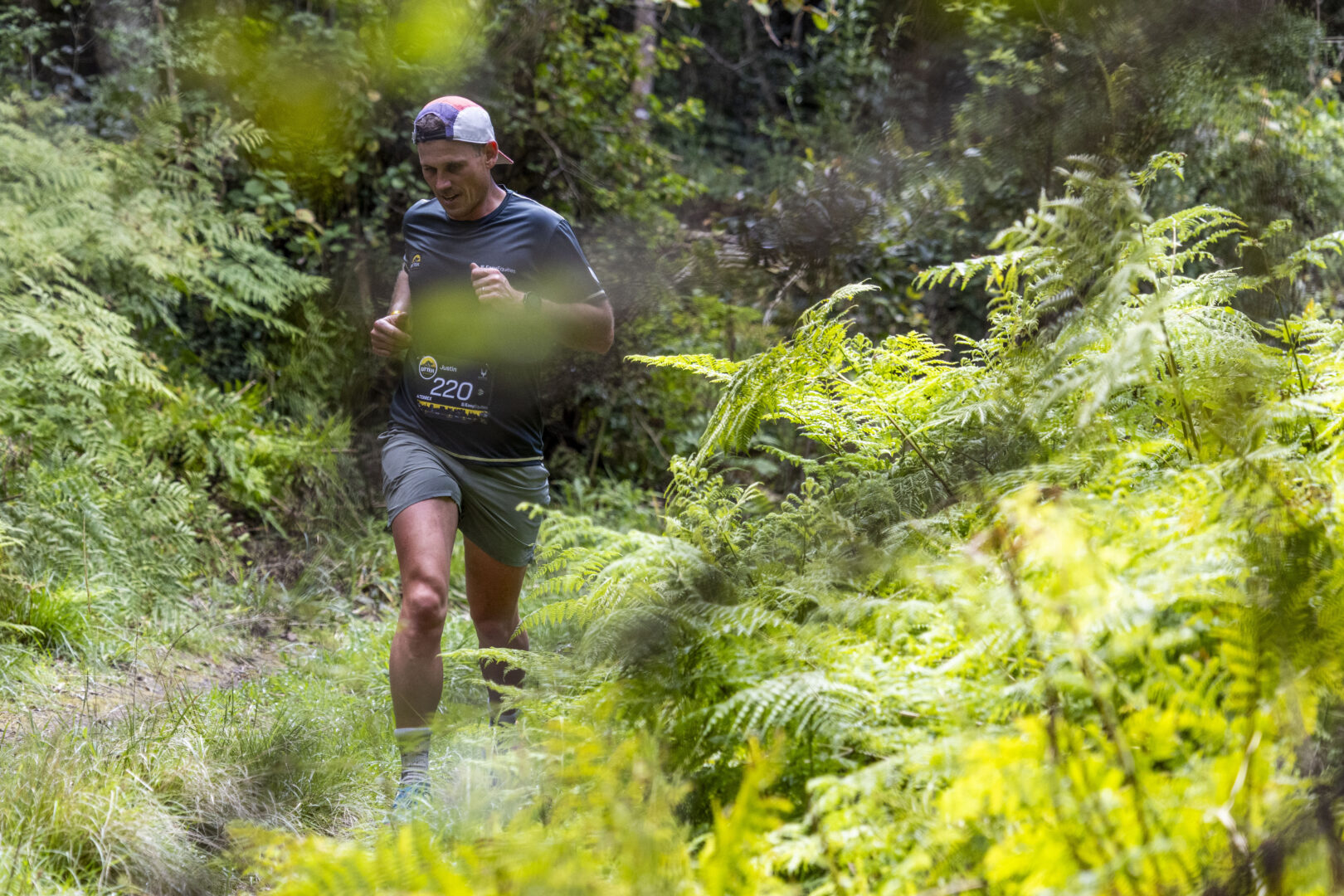
At last year’s Otter TERREX Trail, presented by EasyEquities, defending champion Robbie Simpson flew off the start line, blazing across the beach and dropping his competitors within the first kilometer. But, by the time he reached the Andre Hut checkpoint, something was off: he’d dropped to fifth.
The reason? A wrong turn down a narrow fishing path.
While it might have cost him a few minutes, that misstep is a perfect entry point to a much bigger story. It is one that weaves through the undergrowth of the Tsitsikamma, through history, heritage, and how we think about conservation today.

The Trails Adjacent to Our Race
The path Robbie took wasn’t random. It was one of the many fishing paths carved into the coastline by generations of local communities who have lived off this land and sea for centuries; long before it became a national park, long before it became the ‘Otter Trail’.
These paths exist because people still walk them; whether to fish, to gather, or to access places their families have known for generations. In South Africa, this kind of use isn’t just tradition, it’s a right. Customary rights are enshrined in our Constitution, ensuring that Indigenous and local communities can continue their cultural and subsistence practices, even within conservation areas.
As Victor Mokoena, SANParks Garden Route Region General Manager, puts it: “you can’t just come in, fence off land, and tell people they’re no longer allowed access. If they’ve lived here and fished here for generations, that right doesn’t just vanish.”
When Conservation Clashes with Culture

In many places, the creation of protected areas has come at the cost of community access. Areas once used to sustain families have been locked behind bureaucratic gates. Permits cost money. Enforcement arrives without conversation. And, people who’ve always belonged suddenly feel like outsiders. It’s no wonder that resentment grows. Or that terms like poacher get thrown around too loosely.
Victor challenges the dominant conservation narrative: “we ask ourselves, who’s the real threat to the ocean? The local fisherman catching just enough to feed his family? Or the industrial operations pulling tonnes from the sea every day?” He’s clear: “It’s not the guy standing on the rocks with a line in the water. It’s the big trawlers out there scraping the ocean floor.”
A Model of Coexistence
What Victor and his team have done differently in Tsitsikamma is worth celebrating. Rather than exclude, they’ve chosen to invite communities in. They’ve worked with local leaders to ensure access via historic fishing paths remains open.
This approach, community-inclusive conservation, is not only more just, it’s also more effective. “People look after what they feel a part of,” says Victor. “If you give them a stake, they become protectors, not just users.”
He believes too that self-sustainable, traditional fishing practices are conservation in action. They’re guided by knowledge passed down through generations, about seasons, breeding cycles, and respect for natural limits. “Local people need to be part of the bigger picture. If you don’t bring them along, you won’t get far,” he adds.

Reframing the Word “Poacher”
Victor challenges us to rethink the labels we use: “next time you hear someone say poacher, ask: Is this a father catching supper? Or is it a multinational draining resources for profit?” In a world quick to criminalise poverty but slow to regulate exploitation, this perspective matters.
More Than a Trail, It’s a Shared Journey.
Robbie Simpson did make his way back up the field, catching Kane Reilly on the final boulder section to win his back-to-back Otter title. But, his brief detour brought the spotlight, even if unintentionally, to the layers of heritage and tradition beneath the Otter Trail.
So, next time you spot a narrow path veering off the main trail, don’t see it as a mistake. See it as a reminder: these landscapes carry the footsteps of many. Some run for podiums. Some walk for supper. All deserve space.